Salahuddin Rabbani
Ninety years ago, Afghanistan and Turkey signed a treaty of friendship, on March 1, 1921. Two years before the establishment of the Republic of Turkey, the Ottoman officials and the representatives of the Afghan government signed the friendship treaty. Two years later in 1923, Afghanistan was one of the first countries to recognize the Republic of Turkey. With the establishment of the Turkish Republic, the cordial relations that existed between the two brotherly countries further strengthened and entered into a new phase of intense cooperation.
The two countries have always been very close friends. As a true friend, Turkey has always been ready to assist Afghanistan. Turkey’s constructive involvement in Afghanistan is not a recent phenomenon. In the 1920s, when Afghanistan embarked on building a modern National Army, it sought Turkish assistance in building its military institution. The role played by the Turkish officers in building the Afghan Army will always remain as an important part of our history. Turkey’s role, however, was not limited to building our military institutions. Health and education were the other important areas where Turkey played a crucial role.
March 2, 2011
March 1, 2011
Serbian Military Headquarters Turned into a Turkish School
Milliyet
A building in Sarajevo's Vraca neighborhood that was once a command base at which Serbian fascists used to torture Bosnian prisoners during the war (1992-1995) is now serving as a Turkish school where Bosnian, Serbian and Croatian students are receiving an education under the same roof.
The schools founded by Turkish volunteers in the aftermath of the war have become among the most successful schools in the country. The building of the first Turkish school among the 7 elementary and high schools, and a university stands out with a different story.
February 28, 2011
New university with Turkish collaboration on the cards
The News International
Chief Minister Shahbaz Sharif has said that Pakistan and Turkey have historic and cultural relations and people of both the countries are bound together in strong fraternal ties.
Speaking at the foundation stone laying ceremony of boys’ hostel in the main campus of Pak-Turk International School and College at Khayaban-e-Jinnah Road here on Sunday, he said Turkey was a sincere friend of Pakistan and it always helped the latter in the hour of need. He said schools and colleges of Pak-Turk Foundation were playing a commendable role for promotion of quality education and the provincial government would extend all-out cooperation to them for the purpose.
February 27, 2011
Shining Turkish schools cement Iraq’s social unity
Aziz İstegün
Iraq has been experiencing unrest for seven of the last 30 years. The Halabja massacre, the US invasion, the overthrowing of Saddam Hussein, the sectarian conflicts and the problems concerning how to share political power have split the country into three regions, although not de jure: the Shiites to the south, the Sunnis in and around Baghdad and the Kurds to the north.
In Iraq, a country where demands for de jure or de facto segregation are frequently voiced, there are certain institutions that have been advocating peaceful coexistence since 1994. Moreover, these institutions put this idea into practice. The name of these institutions that cement Iraq’s integrity is the Ishik (Light) Schools.
February 26, 2011
Turkish investors eye Kenyan school sector
Mwakera Mwajefa & Mazera Ndurya
Turkish investors have set their sights on the Kenyan education sector following the success story of a chain of schools in Nairobi and Mombasa.
The four schools, operating under the Light Academy brand, were set up by Turkish businessmen to cater for Kenya’s fast-growing middle class.
The businessmen now plan to establish one more school in Kisumu and a private university.
More than 200 Turkish investors have in the past month visited Nairobi and Mombasa to explore business opportunities.
February 25, 2011
Turkey, Vietnam sign MoU to bolster bilateral ties
Ömer Şahin
Deputy Prime Minister Bülent Arınç, who embarked on a Southeast Asian tour last weekend, signed a memorandum of understanding Vu (MoU) with Vietnam's Minister of Trade and Industry V Huy Hoàng in Hanoi on Wednesday.
Deputy Prime Minister Bülent Arınç, who embarked on a Southeast Asian tour last weekend, signed a memorandum of understanding Vu (MoU) with Vietnam's Minister of Trade and Industry V Huy Hoàng in Hanoi on Wednesday.
February 24, 2011
Caught unprepared
Kerim Balcı
I have always admired my nation’s solution-oriented creativity in times of crisis. Whenever a problem emerges, a brilliant touch of genius comes out and finds a way either to bypass or to solve, or at least to internalize and make peace with, the problem.
This is, I believe, one of the human sides of my nation, as opposed to the systemic successes of the Western mind. There, the system assures that the people should not make mistakes; here, the people find ways to cope with the mistakes and even turn them into success stories.
February 23, 2011
Zaman University
Ret. Rev. Dr. Yap Kim Hao
Zaman University was officially opened in Phnom Penh on February 21. 2011 by the Deputy Prime Ministers of Cambodia and Turkey signalling the significance of this event. This educational development was encouraged by the government of Cambodia and responded by the Turkish Muslim community who are inspired and guided by the Gulen movement. They have established educational institutions in Eastern Europe, Asia and even in the United States. These schools promote high standards of education in science and technology, inter-faith relations and moral and spiritual value regardless of race & religion, sex & gender preference as their contribution to the 21st century in this pluralistic world.
Business people in Turkey voluntary contributed to support this noble endeavour. For this occasion 60 businessmen flew in from Turkey to participate in the Opening Ceremony.
February 22, 2011
The Turkish School in Kathmandu made a dream come true
Zaman
Ahmet Davutoglu the first Turkish foreign secretary who went to Nepal visited Meridian Turkish School. Davutoglu addressed to the students in Turkish school and said that: "My first visit to Nepal was in 1993. If someone had told me that a Turkish school would be opened in Kathmandu, the students in that school would learn to speak Turkish and would sing Turkish songs, I would think that it would be only a dream. But now I see that these devoted Turkish teachers realized that dream and I'd like to thank to all of the teachers”.
Ahmet Davutoglu the first Turkish foreign secretary who went to Nepal visited Meridian Turkish School. Davutoglu addressed to the students in Turkish school and said that: "My first visit to Nepal was in 1993. If someone had told me that a Turkish school would be opened in Kathmandu, the students in that school would learn to speak Turkish and would sing Turkish songs, I would think that it would be only a dream. But now I see that these devoted Turkish teachers realized that dream and I'd like to thank to all of the teachers”.
February 21, 2011
The Gülen Movement: Paradigms, Projects and Aspirations
Simon Robinson
The Gülen movement has become an area of study on its own. No year passes without an academic or semiacademic conference being held in a Western university. This year the Niagara Foundation of Chicago, together with several academic institutions, organized "The Gülen movement: Paradigms, Projects and Aspirations" conference. Professor Simon Robinson was there not only to participate, but also to cover the event for Turkish Review.
The Gülen movement has become an area of study on its own. No year passes without an academic or semiacademic conference being held in a Western university. This year the Niagara Foundation of Chicago, together with several academic institutions, organized "The Gülen movement: Paradigms, Projects and Aspirations" conference. Professor Simon Robinson was there not only to participate, but also to cover the event for Turkish Review.
February 20, 2011
Fethullah Gülen: An Islamic sign of hope for an inclusive Europe
Paul Weller*
As Europe heads deeper into economic recession, political crises and loss of social equilibrium, an increasingly diverse continent faces potentially serious challenges to cohesion, justice and equity.
The Europe of history, rather than of ideology, has always been a context for religious and cultural diversity, with a longstanding and substantial presence of Jews and Muslims, as well as Christians. But there have also always been ideological attempts to deny and/or destroy that diversity. This began when pre-Christian pagan traditions were replaced with Christianity --often (though not always) by means of force.
February 19, 2011
Oxford Analytica versus Turkish democracy
İhsan Yılmaz
Last week the US ambassador to Turkey created havoc when he directly commented on a legal case and declared that he was confused about freedom of the press in Turkey. The case in point concerns the infamous Ergenekon terrorist organization and journalist Soner Yalçın, who has been charged for being a member of the organization.
Based on the evidence presented to it, a court has jailed Mr. Yalçın pending trial. I am sure that within a few months we will able to read the indictment and evaluate for ourselves if he is in prison for his journalistic activities or if journalism was a cover for his illegal activities. But some in Turkey, including the US ambassador, have been quick to claim that Mr. Yalçın is innocent and that the Justice and Development Party (AK Party) and the Gülen movement have been unjustly trying to silence the opposition.
February 18, 2011
A Turkish citizen spreads a message of love and coexistence from the U.S.
Brian Knowlton
Fethullah Gülen is a name that was discovered by the world media only recently. He and the vast education network operating throughout the world that sympathizes with his thoughts received the attention of Western intellectuals primarily because he was seen as the antithesis of radical Islam. Gülen, though, does not have a dialectic view of history and does not want to be labeled 'anti' anything.
Fethullah Gülen, the Turkish educator and spiritual leader, has lived in a bucolic retreat outside the small town of Saylorsburg, Pennsylvania, since 1998. That was the location of a wide-ranging interview granted earlier this year to Brian Knowlton from the International Herald Tribune. The following text is based both on the interview and on questions submitted earlier to Mr. Gülen; the answers were translated from the Turkish by his assistants. Together they formed the basis of an article by Mr. Knowlton that appeared both in the International Herald Tribune and on the website of The New York Times.
 |
| Fethullah Gulen |
Fethullah Gülen, the Turkish educator and spiritual leader, has lived in a bucolic retreat outside the small town of Saylorsburg, Pennsylvania, since 1998. That was the location of a wide-ranging interview granted earlier this year to Brian Knowlton from the International Herald Tribune. The following text is based both on the interview and on questions submitted earlier to Mr. Gülen; the answers were translated from the Turkish by his assistants. Together they formed the basis of an article by Mr. Knowlton that appeared both in the International Herald Tribune and on the website of The New York Times.
February 17, 2011
Islam and Peace: Oxymoron or perfect match?
Hakan Yeşilova
For many decades, perhaps centuries, "Islam" and "peace" were a pair of incongruous words. "Peace" was like Troy, many thought, and Muslims were the attacking Greeks -- how fictional or factual Homer's "Iliad" was, and thus how true it was that Troy lay in the East and was innocent, is a matter of research yet to be convincingly conducted.
For many decades, perhaps centuries, "Islam" and "peace" were a pair of incongruous words. "Peace" was like Troy, many thought, and Muslims were the attacking Greeks -- how fictional or factual Homer's "Iliad" was, and thus how true it was that Troy lay in the East and was innocent, is a matter of research yet to be convincingly conducted.
February 16, 2011
Can Turkey Inspire Reform in the Muslim World?: A closer look to the Gulen Movement
Tarek Ezzat
Independence is possibly one of the main reasons of its success, and the fact that Turkey was one of the few Muslim countries which was not subject to foreign occupation during the era of European Colonial expansion in the 19th. & 20th. Century. A second factor is Turkey's geographical location and its close contact with Europe, as part of Turkey is in fact inside Europe, which facilitated the transfer of knowledge and experiences during the last century from other European countries, like Germany, France.
There is today another positive experience of comprehensive reform taking place in a Muslim country, which is also of wide interest to all Muslims, that of Malaysia. Though it was one of the Muslim countries that suffered from foreign occupation, it was fortunate enough to be governed for nearly 20 years by a leader with vision, Dr. Mahatir Muhammad, who managed to create a strategy and master plan for Malaysia in the 21st century, and who was able to implement that plan with focus on better education and development leading to a strong economy and the country's rapid progress and modernization.
February 11, 2011
Turkish experience in Sudan: Making a difference
Abdullah Bozkurt
I was not planning to end up in Darfur last week when I booked the flight to Ankara from Strasbourg, where I covered the winter session of the Parliamentary Assembly of the Council of Europe. In fact, the next day, I was already scheduled to depart for Egypt to meet with the prime minister, foreign minister and other Egyptian officials until I got a last-minute call during a short layover in Munich for a connecting flight.
An official on the phone from the Egyptian Embassy in Ankara was advising me to delay my departure until the dust settled in his homeland. I heeded his advice and cancelled my booking to Cairo. The next day all the officials I was supposed to meet for a series of interviews were sacked by President Hosni Mubarak in an effort to calm growing protest movements. In a way it turned out to be good advice when I saw footage of my colleagues getting beat up and taken away by pro-government thugs in the Egyptian capital.
February 10, 2011
Book Review: Faith, Theology and Service in Peacebuilding
Stanley Ridge*
Fethullah Gülen's work and thinking starts and ends in faith. In a world that commonly extends conflict by speaking of religion either in stereotyped or in ideologized terms, this is a refreshingly engaged perspective.
Faced with the challenge of mounting hostility between the Islamic world and the West, and with belligerent and increasingly fundamentalist groups on both sides supposedly speaking in the name of religion, the need for peacebuilding with integrity is pressing. The writers of different traditions whose essays resonate here explore the faith-based ideas of one of this century's seminal thinkers and tease out their implications and potential for peacebuilding.
February 9, 2011
Islamic Democrats and the Turkish Model
Ahmad Ali Khalid
 There is a realisation that the state must be secular in its institutions but liberal in its outlook, allowing for multiple voices in the public sphere. What we are seeing in the Muslim world is perhaps a return towards the early models of Islamic governance put forward by Islamic reformists and liberals.
The Turkish Justice and Development Party (AKP) and organisations like the Gulen movement represent the logical culmination of the democratic aspirations of the Muslim world. The combination of religious philosophy and liberal values whilst adopting secular state institutions and allowing religious voices a role in the public sphere is the most reasonable framework of democratic governance available to us. ‘Public Islam’ is desirable, but ‘state Islam’ is inevitably totalitarian.

The Turkish Justice and Development Party (AKP) and organisations like the Gulen movement represent the logical culmination of the democratic aspirations of the Muslim world. The combination of religious philosophy and liberal values whilst adopting secular state institutions and allowing religious voices a role in the public sphere is the most reasonable framework of democratic governance available to us. ‘Public Islam’ is desirable, but ‘state Islam’ is inevitably totalitarian.
February 8, 2011
Is the Gülen Movement a Religious Order? *
M. Enes Ergene
Even though the essential dynamics of the Gülen movement look similar to those of the classical Islamic tradition of spiritual orders in certain aspects, its organization is different with regard to producing civil initiatives and its way of acculturation.
Even though the essential dynamics of the Gülen movement look similar to those of the classical Islamic tradition of spiritual orders in certain aspects, its organization is different with regard to producing civil initiatives and its way of acculturation.
February 6, 2011
Defending Religious Diversity and Tolerance in America Today: Lessons from Fethullah Gülen
The Rev. Loye Ashton, Ph.D., Millsaps College
How does Fethullah Gülen integrate both commitment to his own faith and tolerance toward the faith of others? There are at least three approaches within his work that are especially rich for exploring this question.
How does Fethullah Gülen integrate both commitment to his own faith and tolerance toward the faith of others? There are at least three approaches within his work that are especially rich for exploring this question.
February 5, 2011
Esposito: Authoritarian versus democratic politics defines the Turkish debate
Interview with John L. Esposito
An alternative elite group is emerging in Turkey, and Turkey is moving at a good pace in terms of democratization. Certain people speaking to the American audience define the debate in Turkey as a clash between secularists and Islamists, but it is more an issue of democratic versus more authoritarian politics.
In the past you might not have been able to get a position in a university if you had a religious profile, but now, one has to move beyond that. The Turkish government is working with the EU, US and Israel independently on the issues that it sees as in its own national interest.
February 4, 2011
Fethullah Gülen's Response to the "Clash of Civilizations" Thesis
Prof. Richard Penaskovic, Auburn University
What does Fethullah Gülen say about the clash of civilizations? Gülen does not mince words. He fears that such talk about a clash of civilizations might become a self-fulfilling prophecy. Gülen notes that as a consequence of such a claim readers may form expectations in the very same way they expect an answer to prayer. By arguing that the future will involve a clash of civilizations, Huntington converts such an expectation into a purposeful goal. Gülen fears that with such a goal in mind, various policies and strategies will then be marshaled to reach and attain such a goal.
Gülen also has a different vision of the future than does Mr. Huntington. Where Huntington speaks of conflict between civilizations and variant cultures, Gülen is much more sanguine and upbeat about the future. For example, Gülen speaks to the importance of knowledge and education, which if done properly can avert any clash of civilizations. Mr. Gülen equates knowledge and power. Everything in the future will be in the orbit of knowledge.
February 3, 2011
Turkey is our guiding star, says Kyrgyz prime minister
Aydın Pazarcı
 Prime Minister Recep Tayyip Erdoğan is on an official visit to Kyrgyzstan today. The two-day visit, during which the prime minister will be joined by a large delegation, including State Minister Zafer Çağlayan as well as many business figures and journalists, is notable for being the first such high-profile visit in seven years.
In a pre-visit interview with Today’s Zaman, Kyrgyz Prime Minister Almazbek Atambayev said: “Turkey is our North Star, and as Turkey grows and develops, it stands as an example for us. It opens the way forward for its brother nations.” Speaking very good Turkish, Atambayev underscored the importance of this visit by Erdoğan, noting that it means much from the perspective of showing support for the newly formed Kyrgyz government.
“A friend in need is a friend indeed. Turkey, our brother nation, has always been by our side. Our nation has had a particularly trying time since last April, and we have noted Turkey’s presence by our side during these times. Turkey has not withheld a single act of generosity from us,” Atambayev said.
February 2, 2011
Fethullah Gulen’s Care for All Creation as a Means to Nonviolence
Prof. Eileen Eppig, College of Notre Dame
The nonviolent and peaceful lifestyle of Fethullah Gulen reflects the Sufi belief that love is the essential element in every creature. Gulen’s own love extends to the entire universe, which is meant to be “read” by human beings in order to achieve faith, knowledge, and closeness to God. With traditional Sufi theology, Gulen relates the inner meaning of the Qur’an to the inner meaning of the natural world. The Qur’an and the universe are two expressions of the same truth.
 |
| Fethullah Gulen |
The Qur’an calls on human beings to study creation for the sake of knowing the Creator. The natural world, like the Qur’an, reveals the Divine Names and so has a kind of sacredness in it. The universe teaches human beings to demonstrate compassion, not only to other humans, but to every living creature. Gulen calls this “the grand orchestra of love.” All creation is to be loved in the way of God’s loving, replacing violence and hatred with peace and harmony.
January 29, 2011
Condolences and denouncement of terror
M. Fethullah Gülen
All acts of terrorism are major blows dealt to peace and serenity. No matter what the motive behind it is, an act of terror can by no means be accepted or approved of. Major acts of terror in past years have not only impacted the geography where they were carried out, but have also damaged world peace.
For this reason, I harshly denounce the attack that took place at Moscow's Domodedovo Airport no matter by whom and for what purpose it was staged, and I condemn terror. I extend my condolences to the family members of the victims and the Russian people and the Russian authorities. I also hope the injured will get well soon, and I would like to say I share their pain.
Published on en.fgulen.com, 29 January 2011, Saturday
January 28, 2011
Texas Senate passes resolution commending Fethullah Gülen
Ali H. Aslan
| The Senate of the State of Texas on Tuesday passed a resolution commending respected Turkish scholar Fethullah Gülen for his contributions to the promotion of global peace and understanding. | |
| Senate Resolution No. 85, which was approved during Tuesday's session chaired by Texas Lt. Governor David Dewhurst, said, “The Senate of the State of Texas is pleased to recognize "Fethullah Gülen for his ongoing and inspirational contributions to the promotion of global peace and understanding.” The resolution said Turkish scholar, author, poet, preacher and educational activist "Fethullah Gülen has inspired a worldwide social movement that promotes humanistic values and service, known as the Hizmet movement, or the Gülen movement. “Based on the principle that each human being is of value, regardless of background, faith or culture, the Gülen movement offers a multifaceted approach to seeking world peace. It also places a strong emphasis on intercultural understanding and the embracing of differences; it values compassionate acts of care and concern; and it promotes the importance of education in laying the groundwork for fostering better relationships between diverse populations,” read the approved resolution. |
January 27, 2011
Bishop Chane: Fethullah Gulen one of the greatest scholars
Today's Zaman
Eighth Bishop of Washington in the Episcopal Church John Bryson Chane has said Turkish scholar Fethullah Gülen is probably one of the greatest scholars and religious people in today’s world.
Speaking at a Jan. 20 meeting of the Rumi Forum, a think tank established by Turks living in Washington, D.C., to foster intercultural dialogue, the bishop praised Fethullah Gülen and the Gülen movement inspired by him. During his speech, titled “Interfaith/Intercultural dialogue: a First Priority in the 21st Century,” Chane referred to Gülen as a “magnificent man”:
January 20, 2011
Civic engagement, success and the Gülen movement
Muhammed Çetin
The recent extraordinary interest in activities by and related to the Gülen movement leads many to think about civic engagement and its efficacy and success.
Civic engagement is extremely vital for improving and enhancing conditions in any contemporary democracy. It means promoting the quality of life in a community through both political and non-political processes. It means working to make a difference in the civic life of our communities. It develops a combination of knowledge, skills, values and motivation to make that difference.
January 18, 2011
Author of book on Gülen movement receives much interest in Ankara
Today's Zaman
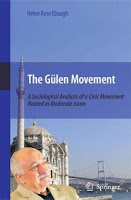 American sociology professor Helen Rose Ebaugh, who has written a book analyzing the Gülen movement, met with thousands of readers in the capital on Sunday and signed her book titled “The Gülen Movement: A Sociological Analysis of a Civic Movement Rooted in Moderate Islam.”
The Gülen movement is a group of volunteers engaged in interfaith and intercultural dialogue inspired by the ideas of Fethullah Gülen, a Turkish Islamic scholar well known for his teachings promoting mutual understanding and tolerance between cultures. Now residing in the US, Gülen has pioneered educational activities in a number of countries, along with efforts to promote intercultural and interfaith activities around the world.

The Gülen movement is a group of volunteers engaged in interfaith and intercultural dialogue inspired by the ideas of Fethullah Gülen, a Turkish Islamic scholar well known for his teachings promoting mutual understanding and tolerance between cultures. Now residing in the US, Gülen has pioneered educational activities in a number of countries, along with efforts to promote intercultural and interfaith activities around the world.
January 16, 2011
‘Gülen movement challenges Islamophobia, contributes to peace’
Dilek Hayirli
American sociology professor Helen Rose Ebaugh, who is also the author of a book analyzing the Gülen movement, said the movement is a powerful challenge to the fears that people have after the 9/11 attacks and also praised the movement for its tremendous contribution to world peace.
The professor visited İstanbul last week upon an invitation from the Journalists and Writers Foundation (GYV) and shared her opinion with Sunday’s Zaman. Ebaugh is known for her book titled “The Gülen Movement: A Sociological Analysis of a Civic Movement Rooted in Moderate Islam.”
The professor visited İstanbul last week upon an invitation from the Journalists and Writers Foundation (GYV) and shared her opinion with Sunday’s Zaman. Ebaugh is known for her book titled “The Gülen Movement: A Sociological Analysis of a Civic Movement Rooted in Moderate Islam.”
January 14, 2011
‘Gülen movement makes Turkey more noticeable’
Fatih Vural, Tuğba Kaplan
A sociologist who has studied the faith-based Gülen movement of Turkey extensively has said the movement helps other countries in the world to become more aware of Turkey.
Helen Rose Ebaugh, the author of “The Gülen Movement: A Sociological Analysis of a Civic Movement Rooted in Moderate Islam,” was in İstanbul yesterday where she attended a panel discussion organized by the Journalists and Writers Foundation. Other speakers who took part in the discussion included Ferhat Kentel, Ömer Laçiner and Ali Bulaç.
Helen Rose Ebaugh, the author of “The Gülen Movement: A Sociological Analysis of a Civic Movement Rooted in Moderate Islam,” was in İstanbul yesterday where she attended a panel discussion organized by the Journalists and Writers Foundation. Other speakers who took part in the discussion included Ferhat Kentel, Ömer Laçiner and Ali Bulaç.
January 12, 2011
Greek broadcaster praises contributions of Gülen movement
Hasan Hacı
The Gülen movement’s contributions to opening Turkey up to the modern world were praised during a one-hour program launched on ERT, Greece’s national broadcaster, on Monday.
The program, titled “Değişen Türkiye” (Turkey Changing), featured the opinions of many leading Greek journalists, academics and politicians on the Gülen movement. Fethullah Gülen was described as a “retired preacher and intellectual” in the program. The program said the Gülen movement, inspired by Fethullah Gülen, supports Turkey’s efforts to keep pace with the modern world. It also said the movement attaches great importance to education, modernization and the coexistence of different cultures.
|
| Fethullah Gulen |
The program, titled “Değişen Türkiye” (Turkey Changing), featured the opinions of many leading Greek journalists, academics and politicians on the Gülen movement. Fethullah Gülen was described as a “retired preacher and intellectual” in the program. The program said the Gülen movement, inspired by Fethullah Gülen, supports Turkey’s efforts to keep pace with the modern world. It also said the movement attaches great importance to education, modernization and the coexistence of different cultures.
January 6, 2011
Fethullah Gülen chair holder praises Gulen movement’s focus on education
Vedat Denizli
Professor Johan Leman, the holder of a chair named after the well-respected Turkish scholar Fethullah Gülen and established last month at the Catholic University of Leuven in Belgium, has said as a movement that attaches much importance to education the Gülen movement is a perfect partner for him to work with.
Professor Johan Leman, the holder of a chair named after the well-respected Turkish scholar Fethullah Gülen and established last month at the Catholic University of Leuven in Belgium, has said as a movement that attaches much importance to education the Gülen movement is a perfect partner for him to work with.
January 1, 2011
Bill Clinton on Fethullah Gulen's Contribution to the World
42nd U.S. President Bill Clinton's delivered his remarks at the 3rd Annual Friendship Dinner by Turkish Cultural Center, New York City, on September 25, 2008. President Clinton offered his thanks to the Gülen Movement for contributions to world peace and security.
December 28, 2010
‘Sonsuz Nur' translated into Zulu
Today's Zaman
“Sonsuz Nur” (Eternal Light), a Turkish-language book about the Prophet Muhammad, has been translated into the Zulu language.
Written by Fethullah Gülen, a Turkish Islamic scholar, the highly praised book is published in several different languages by Tuğra Books.
Officials from the publishing house said their translation of Gülen's books started with “Sonsuz Nur.”
December 18, 2010
Dutch minister gives Turkish deputy a lesson on freedoms
Basri Doğan, Adem Kotan
Dutch Interior Minister Piet Hein Donner has opposed critical remarks by Socialist Party (SP) deputy Saadet Karabulut about the Gülen movement, inspired by internationally respected Turkish scholar Fethullah Gülen, and said the movement is very successful in integrating into Dutch society.
Putting emphasis on freedom of religion and human rights, Donner said the Gülen movement does not pose any threat to the Dutch state, as the deputy argues, but stands as the most successful group among Turks living in the Netherlands with regards to integration.
 |
| Fethullah Gulen |
Putting emphasis on freedom of religion and human rights, Donner said the Gülen movement does not pose any threat to the Dutch state, as the deputy argues, but stands as the most successful group among Turks living in the Netherlands with regards to integration.
December 17, 2010
Gülen movement won’t form alliance with PKK
Aziz Üstel
Why can’t the Gülen movement make an alliance with the PKK? Because the esteemed Fethullah Gülen, an Islamic religious scholar, is someone who is disgusted by every form of violence and opposes the use of violence.
The Gülen movement does not put the Kurdish citizens of Turkey in the same basket as the PKK. The movement is totally against the establishment of an autonomous region in the country’s Southeast. The co-chairman of the Peace and Democracy Party (BDP), Selahattin Demirtaş, clearly said an alliance with the Gülen movement is out of the question. The reason is the “incompatibility” of the two movements. By the way, there is something about which Demirtaş is mistaken, his argument that the Gülen-PKK alliance issue was brought up by Zaman columnist Hüseyin Gülerce. It was not Gülerce, but Öcalan’s lawyers who brought up this claim.
Published on Today's Zaman, 16 December 2010, Thursday /
(translated from the original piece that appeared on Star Newspaper, 15 December 2010)
December 9, 2010
Catholic University of Leuven establishes Fethullah Gülen Chair
Hatice Avci
 A chair named after the well-respected Turkish scholar Fethullah Gülen has been established at one of Belgium’s most prestigious Catholic universities, the Catholic University of Leuven, with university officials saying it is a source of pleasure for them to have a chair named after Gülen.

December 8, 2010
A global community: Gulen Movement
Kadri Gursel
I spent the week before the Kurban Bayram, or “Feast of the Sacrifice,” holiday in Chicago to follow a conference on the Gülen movement.
Today the community has reached the status of a transnational movement. Though it is not possible to identify the Gülen movement as a “political organization,” the movement is imbedded in politics today and is an unelected coalition partner of single-party rule in Turkey. This partnership renders the movement the natural partner of the suspicion and distrust some feel toward the party currently in power.
December 3, 2010
‘Turkish schools key to success in Africa'
Today's Zaman
Deputy Prime Minister and State Minister Bülent Arınç noted that the Turkish schools that have opened in various parts of Africa have contributed significantly to the development of ties between Turkey and Africa.
“Relations between different peoples are a multi-faceted issue, one can't see this in terms of just trade or Turkey's investments,” Arınç said. “There are other factors, such as culture, traditions and cooperation in education. Thank God the best quality education in Uganda is being given by the Turkish Light Academy set up in Kampala 10 years ago.
November 30, 2010
Imam who lives in rural Pennsylvania arouses praise, concerns
Andrew Conte
SAYLORSBURG — Just a short drive on a two-lane road from the Dunkin' Donuts here, the Golden Generation Retreat Center hardly seems like the home of one of the world's leading Islamic thinkers.
A metal gate at the driveway stands open, and no fences or walls protect the 25-acre property from suburban homes and rolling hillsides nearby. Officials recently invited their neighbors to celebrate the opening of a three-story meeting center and share a Thanksgiving feast.
November 26, 2010
Supporters Gather Over Gulen Movement
Zaman, US
Scholars from around the world gathered for a conference in Chicago to talk about the Gulen movement and Fethullah Gulen. Organizers say the meeting was necessary because fear and hatred continue to influence public opinion and there is a need to focus on people and groups that promote peace and understanding.
Scholars from around the world gathered for a conference in Chicago to talk about the Gulen movement and Fethullah Gulen. Organizers say the meeting was necessary because fear and hatred continue to influence public opinion and there is a need to focus on people and groups that promote peace and understanding.
November 23, 2010
‘Fethullah Gulen not only my hero, also a model for other religions’
Hatice Avcı
A leading American minister has said all religions need an adherent like Fethullah Gülen, a Turkish-Islamic scholar whose teachings focusing on interfaith dialogue have been widely lauded around the world.
“He is not only my hero for what he has done for the Muslim societies but also [offers] a model for all other religions,” said Dirk Ficca, executive director of the Chicago-based Council for a Parliament of the World’s Religions, an international NGO aiming to cultivate better understanding between the world’s religious and spiritual communities by highlighting the similarities while also acknowledging the differences between them.
 |
| Fethullah Gulen |
“He is not only my hero for what he has done for the Muslim societies but also [offers] a model for all other religions,” said Dirk Ficca, executive director of the Chicago-based Council for a Parliament of the World’s Religions, an international NGO aiming to cultivate better understanding between the world’s religious and spiritual communities by highlighting the similarities while also acknowledging the differences between them.
November 22, 2010
‘Turkey facing hurdles in its EU journey because of Europe’s identity crisis’
Mustafa Edib Yilmaz
A leading researcher at the Washington, D.C.,-based Middle East Institute (MEI) has said Europe is currently going through a process of redefining its own identity, which plays and will continue to play a decisive role in Turkey’s accession process.
MEI Center for Turkish Studies Executive Director Gönül Tol agreed to speak with Sunday’s Zaman in İstanbul. Tol, who received her doctoral degree in political science from Florida International University, argued that the Enlightenment and its core ideals of human autonomy, progress, importance of reason and secularism formed the cornerstone of a common European identity, which opposed the role of established religion in directing thought and action. This new identity, Tol argues, defined a new role for religion outside the realm of the public sphere.
November 21, 2010
Towards ‘the conference-i kamil’ (2)
İhsan Yılmaz
Last week I started writing about the International Conference on the Gülen Movement held in Chicago, titled “The Gülen Movement: Paradigms, Projects and Aspirations,” and promised to continue this week.
On the second day of the conference, the first panel was titled “Sociological Approaches to the Hizmet Movement” and the speakers were Suveyda Karakaya of the University of Tennessee, Gökhan Bacık of Zirve University, and Muhammed Çetin of East Stroudsburg University.
Karakaya’s paper “Women in the Hizmet Movement: Traditionalists or Modernists?” examines the attitudes of 250 women affiliates from diverse backgrounds -- residing in Turkey and the US -- regarding controversial issues such as women’s access to higher education and employment, dress styles (including the headscarf) and their roles in the movement.
 |
| Int. Gulen Conference in Chicago |
On the second day of the conference, the first panel was titled “Sociological Approaches to the Hizmet Movement” and the speakers were Suveyda Karakaya of the University of Tennessee, Gökhan Bacık of Zirve University, and Muhammed Çetin of East Stroudsburg University.
Karakaya’s paper “Women in the Hizmet Movement: Traditionalists or Modernists?” examines the attitudes of 250 women affiliates from diverse backgrounds -- residing in Turkey and the US -- regarding controversial issues such as women’s access to higher education and employment, dress styles (including the headscarf) and their roles in the movement.
November 20, 2010
Concerns, the Community [Gulen Movement] and response
Hüseyin Gülerce
Any reference to “the Community” in Turkey prompts people to think of those who have adopted Fethullah Gülen’s advice, his style and his method in serving this religion.
The word “community” refers to a religion formation and therefore, is accompanied by an implication of organization. The problems or concerns about the Gülen movement can largely be attributed to this implication and the perceptions resulting from it.
November 19, 2010
Are we to wait for our Fethullah Gulen?
Serhii Lashchenko
I first heard about Fethullah Gulen during last year’s Ukraine-Turkey symposium on “Integration problems of scientific, educational and intellectual potential in the process of state creation.” He was among the first Islamic scientists to comment on the terrorist acts of September 11, and the tragic events in Beslan. In his interviews Gulen emphasized: “The murder of one innocent being is equal to the murder of the whole of humanity.” In the Turkish thinker’s opinion, religion in its essence is the furthest away from social, moral and spiritual violence.”
|
| Fethullah Gulen |
November 15, 2010
Lessons from Turkey
Usman Mujib Shami
The Deep State, the name given by pro-democracy Turks to the alliance of the judiciary and military, has gradually lost strength and authority at the hands of the wisdom and vision displayed by the political leadership, a quality rarely found amongst the leaders of our country.
Think of a country marked with a history of frequent military interventions, political instability, human rights violations, and fierce standoffs between its right and left wings; a place where thousands have lost their lives to the quarrels triggered by the religious, ideological, and ethnic differences. Reading these lines, you might be thinking of Pakistan.
Think of a country marked with a history of frequent military interventions, political instability, human rights violations, and fierce standoffs between its right and left wings; a place where thousands have lost their lives to the quarrels triggered by the religious, ideological, and ethnic differences. Reading these lines, you might be thinking of Pakistan.
Towards ‘the conference-i kamil’ (1)
İhsan Yılmaz
As a member of its editorial board, I am attending the Chicago 2010 International Conference on the Gülen Movement.
The conference organizers rightly highlighted: “As we complete the first decade of the 21st century, the advancements in communication and transportation have yet to enable better mutual understanding and appreciation among fellow humans. Misinformation, fear and hatred continue to influence public opinion.”
Among many other victims, it is obvious that the Gülen movement has suffered from these as well. “While the movement has been praised as a catalyst for creating a better world, it has also been criticized by some and the motivations of the participants called [into] question. This international conference has been designed to explore the movement from a social sciences and humanities perspective in order to provide a clearer picture of what the movement participants support and believe,” said organizers.
|
| Int. Gulen Conference in Chicago |
The conference organizers rightly highlighted: “As we complete the first decade of the 21st century, the advancements in communication and transportation have yet to enable better mutual understanding and appreciation among fellow humans. Misinformation, fear and hatred continue to influence public opinion.”
Among many other victims, it is obvious that the Gülen movement has suffered from these as well. “While the movement has been praised as a catalyst for creating a better world, it has also been criticized by some and the motivations of the participants called [into] question. This international conference has been designed to explore the movement from a social sciences and humanities perspective in order to provide a clearer picture of what the movement participants support and believe,” said organizers.
November 10, 2010
The transformation of the Turkish Muslim mind
Mustafa Akyol
VIENNA – The Austrian capital has stunning buildings, impressive museums and delicious schnitzels. But, besides all that, what really brought me here for a short visit is the booming community of Turkish students who have found not just good education but also religious freedom in this far-away land.
VIENNA – The Austrian capital has stunning buildings, impressive museums and delicious schnitzels. But, besides all that, what really brought me here for a short visit is the booming community of Turkish students who have found not just good education but also religious freedom in this far-away land.
November 6, 2010
Event promotes religious and environmental dialogue
John Corrigan
On Thursday, Nov. 4, an event to promote intercultural dialogue titled “Making Peace With and In the World: The Role of The Gulen Movement in the Task of Eco-Justice,” took place in the Student Center.
Sponsored by the Philadelphia Dialogue Forum, the Rumi Student Association and Temple’s Department of Religion, the conference consisted of religious scholars and environmentalists discussing Gulen’s influence on encouraging peace in humanity.
“We’ve held conferences nationwide colleges and cultural centers,” said Philadelphia Dialogue Forum President Omer Genc. “There must be dialogue between people of different faiths to achieve peace around the world.”
Fethullah Gulen is a Turkish Muslim scholar who advocates human rights, interfaith dialogue, and harmonious coexistence.
November 5, 2010
Education conference on "The Gülen Movement Model of Education"
Salih Yücel & Mahsheed Ansari
Just days before the latest catastrophic tsunami hit the West coast of Indonesia, an important conference was held in the heart of country’s capital, Jakarta, on Oct. 19-22.
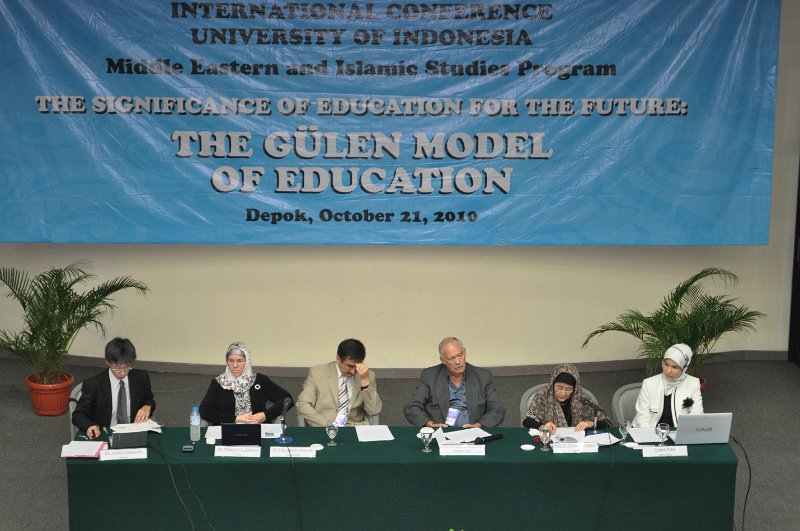
In the poverty stricken country that hosts one of the world’s largest Muslim populations, the International Fethullah Gülen Conference opened its doors to scholars from around the world, and in particular from Southeast Asia, South Asia and Australasia, to discuss a most timely topic of “The Significance of Education for the Future: The Gülen Model of Education.”
 |
| Fethullah Gulen Conference |
In the poverty stricken country that hosts one of the world’s largest Muslim populations, the International Fethullah Gülen Conference opened its doors to scholars from around the world, and in particular from Southeast Asia, South Asia and Australasia, to discuss a most timely topic of “The Significance of Education for the Future: The Gülen Model of Education.”
October 29, 2010
Rumi Forum bestows Peace and Dialogue Awards
Ali H. Aslan
 The Rumi Forum, a think tank established by Turks living in Washington, D.C., to foster intercultural dialogue, has presented its traditional Peace and Dialogue Awards.
The 2010 Rumi Peace and Dialogue Awards ceremony was held on Tuesday at the National Press Club's Ballroom in Washington, D.C. The think thank gave awards to extraordinary individuals and organizations who have contributed much of their time, energy, leadership and dedication to the causes of dialogue, understanding, peace and community service.
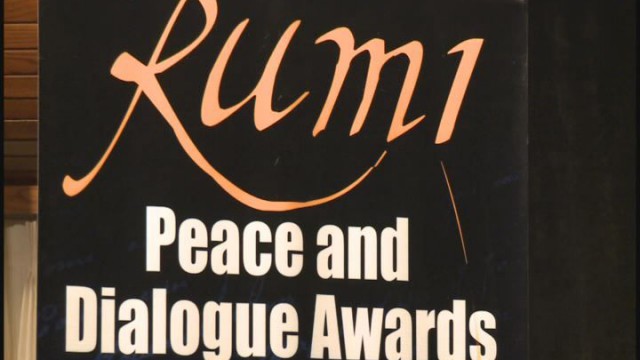
The 2010 Rumi Peace and Dialogue Awards ceremony was held on Tuesday at the National Press Club's Ballroom in Washington, D.C. The think thank gave awards to extraordinary individuals and organizations who have contributed much of their time, energy, leadership and dedication to the causes of dialogue, understanding, peace and community service.
Kimse Yok Mu to distribute meat in 44 countries
Today's Zaman
A leading Turkish charity has organized an extensive campaign to deliver red meat to people in need in 44 countries around the world.
Kimse Yok Mu (Is Anybody There) is continuing its collection of livestock donations for the approaching religious festival of Eid al-Adha (Feast of the Sacrifice), during which all able Muslims are required to sacrifice an animal to God. The four-day festival will begin on Nov. 16.
October 27, 2010
The Hanefi Avcı affair: a dramatic detective story (2)
Faruk Mercan
Sarp Kuray, a former naval officer accused of having founded the 16 Haziran (or June 16) terrorist organization, says: “...The people who staged those attacks without my orders are freely walking around outside.
I, on the other hand, was sentenced to life in jail as the only convict…I myself am clueless about how the organization was able to gather so much intelligence.”
The meaning of these words is clear as daylight. Sarp Kuray is implying that control of the 16 Haziran organization was taken out of his hands by secret intelligence units within the state.
Subscribe to:
Posts (Atom)
