| The Senate of the State of Texas on Tuesday passed a resolution commending respected Turkish scholar Fethullah Gülen for his contributions to the promotion of global peace and understanding. | |
| Senate Resolution No. 85, which was approved during Tuesday's session chaired by Texas Lt. Governor David Dewhurst, said, “The Senate of the State of Texas is pleased to recognize "Fethullah Gülen for his ongoing and inspirational contributions to the promotion of global peace and understanding.” The resolution said Turkish scholar, author, poet, preacher and educational activist "Fethullah Gülen has inspired a worldwide social movement that promotes humanistic values and service, known as the Hizmet movement, or the Gülen movement. “Based on the principle that each human being is of value, regardless of background, faith or culture, the Gülen movement offers a multifaceted approach to seeking world peace. It also places a strong emphasis on intercultural understanding and the embracing of differences; it values compassionate acts of care and concern; and it promotes the importance of education in laying the groundwork for fostering better relationships between diverse populations,” read the approved resolution. |
January 28, 2011
Texas Senate passes resolution commending Fethullah Gülen
Ali H. Aslan
January 27, 2011
Bishop Chane: Fethullah Gulen one of the greatest scholars
Today's Zaman
Eighth Bishop of Washington in the Episcopal Church John Bryson Chane has said Turkish scholar Fethullah Gülen is probably one of the greatest scholars and religious people in today’s world.
Speaking at a Jan. 20 meeting of the Rumi Forum, a think tank established by Turks living in Washington, D.C., to foster intercultural dialogue, the bishop praised Fethullah Gülen and the Gülen movement inspired by him. During his speech, titled “Interfaith/Intercultural dialogue: a First Priority in the 21st Century,” Chane referred to Gülen as a “magnificent man”:
Eighth Bishop of Washington in the Episcopal Church John Bryson Chane has said Turkish scholar Fethullah Gülen is probably one of the greatest scholars and religious people in today’s world.
Speaking at a Jan. 20 meeting of the Rumi Forum, a think tank established by Turks living in Washington, D.C., to foster intercultural dialogue, the bishop praised Fethullah Gülen and the Gülen movement inspired by him. During his speech, titled “Interfaith/Intercultural dialogue: a First Priority in the 21st Century,” Chane referred to Gülen as a “magnificent man”:
January 20, 2011
Civic engagement, success and the Gülen movement
Muhammed Çetin
The recent extraordinary interest in activities by and related to the Gülen movement leads many to think about civic engagement and its efficacy and success.
Civic engagement is extremely vital for improving and enhancing conditions in any contemporary democracy. It means promoting the quality of life in a community through both political and non-political processes. It means working to make a difference in the civic life of our communities. It develops a combination of knowledge, skills, values and motivation to make that difference.
The recent extraordinary interest in activities by and related to the Gülen movement leads many to think about civic engagement and its efficacy and success.
Civic engagement is extremely vital for improving and enhancing conditions in any contemporary democracy. It means promoting the quality of life in a community through both political and non-political processes. It means working to make a difference in the civic life of our communities. It develops a combination of knowledge, skills, values and motivation to make that difference.
January 18, 2011
Author of book on Gülen movement receives much interest in Ankara
Today's Zaman
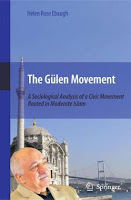 American sociology professor Helen Rose Ebaugh, who has written a book analyzing the Gülen movement, met with thousands of readers in the capital on Sunday and signed her book titled “The Gülen Movement: A Sociological Analysis of a Civic Movement Rooted in Moderate Islam.”
The Gülen movement is a group of volunteers engaged in interfaith and intercultural dialogue inspired by the ideas of Fethullah Gülen, a Turkish Islamic scholar well known for his teachings promoting mutual understanding and tolerance between cultures. Now residing in the US, Gülen has pioneered educational activities in a number of countries, along with efforts to promote intercultural and interfaith activities around the world.

The Gülen movement is a group of volunteers engaged in interfaith and intercultural dialogue inspired by the ideas of Fethullah Gülen, a Turkish Islamic scholar well known for his teachings promoting mutual understanding and tolerance between cultures. Now residing in the US, Gülen has pioneered educational activities in a number of countries, along with efforts to promote intercultural and interfaith activities around the world.
January 16, 2011
‘Gülen movement challenges Islamophobia, contributes to peace’
Dilek Hayirli
American sociology professor Helen Rose Ebaugh, who is also the author of a book analyzing the Gülen movement, said the movement is a powerful challenge to the fears that people have after the 9/11 attacks and also praised the movement for its tremendous contribution to world peace.
The professor visited İstanbul last week upon an invitation from the Journalists and Writers Foundation (GYV) and shared her opinion with Sunday’s Zaman. Ebaugh is known for her book titled “The Gülen Movement: A Sociological Analysis of a Civic Movement Rooted in Moderate Islam.”
The professor visited İstanbul last week upon an invitation from the Journalists and Writers Foundation (GYV) and shared her opinion with Sunday’s Zaman. Ebaugh is known for her book titled “The Gülen Movement: A Sociological Analysis of a Civic Movement Rooted in Moderate Islam.”
January 14, 2011
‘Gülen movement makes Turkey more noticeable’
Fatih Vural, Tuğba Kaplan
A sociologist who has studied the faith-based Gülen movement of Turkey extensively has said the movement helps other countries in the world to become more aware of Turkey.
Helen Rose Ebaugh, the author of “The Gülen Movement: A Sociological Analysis of a Civic Movement Rooted in Moderate Islam,” was in İstanbul yesterday where she attended a panel discussion organized by the Journalists and Writers Foundation. Other speakers who took part in the discussion included Ferhat Kentel, Ömer Laçiner and Ali Bulaç.
Helen Rose Ebaugh, the author of “The Gülen Movement: A Sociological Analysis of a Civic Movement Rooted in Moderate Islam,” was in İstanbul yesterday where she attended a panel discussion organized by the Journalists and Writers Foundation. Other speakers who took part in the discussion included Ferhat Kentel, Ömer Laçiner and Ali Bulaç.
January 12, 2011
Greek broadcaster praises contributions of Gülen movement
Hasan Hacı
The Gülen movement’s contributions to opening Turkey up to the modern world were praised during a one-hour program launched on ERT, Greece’s national broadcaster, on Monday.
The program, titled “Değişen Türkiye” (Turkey Changing), featured the opinions of many leading Greek journalists, academics and politicians on the Gülen movement. Fethullah Gülen was described as a “retired preacher and intellectual” in the program. The program said the Gülen movement, inspired by Fethullah Gülen, supports Turkey’s efforts to keep pace with the modern world. It also said the movement attaches great importance to education, modernization and the coexistence of different cultures.
 |
| Fethullah Gulen |
The program, titled “Değişen Türkiye” (Turkey Changing), featured the opinions of many leading Greek journalists, academics and politicians on the Gülen movement. Fethullah Gülen was described as a “retired preacher and intellectual” in the program. The program said the Gülen movement, inspired by Fethullah Gülen, supports Turkey’s efforts to keep pace with the modern world. It also said the movement attaches great importance to education, modernization and the coexistence of different cultures.
January 6, 2011
Fethullah Gülen chair holder praises Gulen movement’s focus on education
Vedat Denizli
Professor Johan Leman, the holder of a chair named after the well-respected Turkish scholar Fethullah Gülen and established last month at the Catholic University of Leuven in Belgium, has said as a movement that attaches much importance to education the Gülen movement is a perfect partner for him to work with.
Professor Johan Leman, the holder of a chair named after the well-respected Turkish scholar Fethullah Gülen and established last month at the Catholic University of Leuven in Belgium, has said as a movement that attaches much importance to education the Gülen movement is a perfect partner for him to work with.
January 1, 2011
Bill Clinton on Fethullah Gulen's Contribution to the World
42nd U.S. President Bill Clinton's delivered his remarks at the 3rd Annual Friendship Dinner by Turkish Cultural Center, New York City, on September 25, 2008. President Clinton offered his thanks to the Gülen Movement for contributions to world peace and security.
December 28, 2010
‘Sonsuz Nur' translated into Zulu
Today's Zaman
“Sonsuz Nur” (Eternal Light), a Turkish-language book about the Prophet Muhammad, has been translated into the Zulu language.
Written by Fethullah Gülen, a Turkish Islamic scholar, the highly praised book is published in several different languages by Tuğra Books.
Officials from the publishing house said their translation of Gülen's books started with “Sonsuz Nur.”
“Sonsuz Nur” (Eternal Light), a Turkish-language book about the Prophet Muhammad, has been translated into the Zulu language.
Written by Fethullah Gülen, a Turkish Islamic scholar, the highly praised book is published in several different languages by Tuğra Books.
Officials from the publishing house said their translation of Gülen's books started with “Sonsuz Nur.”
December 18, 2010
Dutch minister gives Turkish deputy a lesson on freedoms
Basri Doğan, Adem Kotan
Dutch Interior Minister Piet Hein Donner has opposed critical remarks by Socialist Party (SP) deputy Saadet Karabulut about the Gülen movement, inspired by internationally respected Turkish scholar Fethullah Gülen, and said the movement is very successful in integrating into Dutch society.
Putting emphasis on freedom of religion and human rights, Donner said the Gülen movement does not pose any threat to the Dutch state, as the deputy argues, but stands as the most successful group among Turks living in the Netherlands with regards to integration.
 |
| Fethullah Gulen |
Putting emphasis on freedom of religion and human rights, Donner said the Gülen movement does not pose any threat to the Dutch state, as the deputy argues, but stands as the most successful group among Turks living in the Netherlands with regards to integration.
December 17, 2010
Gülen movement won’t form alliance with PKK
Aziz Üstel
Why can’t the Gülen movement make an alliance with the PKK? Because the esteemed Fethullah Gülen, an Islamic religious scholar, is someone who is disgusted by every form of violence and opposes the use of violence.
The Gülen movement does not put the Kurdish citizens of Turkey in the same basket as the PKK. The movement is totally against the establishment of an autonomous region in the country’s Southeast. The co-chairman of the Peace and Democracy Party (BDP), Selahattin Demirtaş, clearly said an alliance with the Gülen movement is out of the question. The reason is the “incompatibility” of the two movements. By the way, there is something about which Demirtaş is mistaken, his argument that the Gülen-PKK alliance issue was brought up by Zaman columnist Hüseyin Gülerce. It was not Gülerce, but Öcalan’s lawyers who brought up this claim.
Published on Today's Zaman, 16 December 2010, Thursday /
(translated from the original piece that appeared on Star Newspaper, 15 December 2010)
Why can’t the Gülen movement make an alliance with the PKK? Because the esteemed Fethullah Gülen, an Islamic religious scholar, is someone who is disgusted by every form of violence and opposes the use of violence.
The Gülen movement does not put the Kurdish citizens of Turkey in the same basket as the PKK. The movement is totally against the establishment of an autonomous region in the country’s Southeast. The co-chairman of the Peace and Democracy Party (BDP), Selahattin Demirtaş, clearly said an alliance with the Gülen movement is out of the question. The reason is the “incompatibility” of the two movements. By the way, there is something about which Demirtaş is mistaken, his argument that the Gülen-PKK alliance issue was brought up by Zaman columnist Hüseyin Gülerce. It was not Gülerce, but Öcalan’s lawyers who brought up this claim.
Published on Today's Zaman, 16 December 2010, Thursday /
(translated from the original piece that appeared on Star Newspaper, 15 December 2010)
December 9, 2010
Catholic University of Leuven establishes Fethullah Gülen Chair
Hatice Avci
 A chair named after the well-respected Turkish scholar Fethullah Gülen has been established at one of Belgium’s most prestigious Catholic universities, the Catholic University of Leuven, with university officials saying it is a source of pleasure for them to have a chair named after Gülen.

December 8, 2010
A global community: Gulen Movement
Kadri Gursel
I spent the week before the Kurban Bayram, or “Feast of the Sacrifice,” holiday in Chicago to follow a conference on the Gülen movement.
Today the community has reached the status of a transnational movement. Though it is not possible to identify the Gülen movement as a “political organization,” the movement is imbedded in politics today and is an unelected coalition partner of single-party rule in Turkey. This partnership renders the movement the natural partner of the suspicion and distrust some feel toward the party currently in power.
I spent the week before the Kurban Bayram, or “Feast of the Sacrifice,” holiday in Chicago to follow a conference on the Gülen movement.
Today the community has reached the status of a transnational movement. Though it is not possible to identify the Gülen movement as a “political organization,” the movement is imbedded in politics today and is an unelected coalition partner of single-party rule in Turkey. This partnership renders the movement the natural partner of the suspicion and distrust some feel toward the party currently in power.
December 3, 2010
‘Turkish schools key to success in Africa'
Today's Zaman
Deputy Prime Minister and State Minister Bülent Arınç noted that the Turkish schools that have opened in various parts of Africa have contributed significantly to the development of ties between Turkey and Africa.
“Relations between different peoples are a multi-faceted issue, one can't see this in terms of just trade or Turkey's investments,” Arınç said. “There are other factors, such as culture, traditions and cooperation in education. Thank God the best quality education in Uganda is being given by the Turkish Light Academy set up in Kampala 10 years ago.
Deputy Prime Minister and State Minister Bülent Arınç noted that the Turkish schools that have opened in various parts of Africa have contributed significantly to the development of ties between Turkey and Africa.
“Relations between different peoples are a multi-faceted issue, one can't see this in terms of just trade or Turkey's investments,” Arınç said. “There are other factors, such as culture, traditions and cooperation in education. Thank God the best quality education in Uganda is being given by the Turkish Light Academy set up in Kampala 10 years ago.
November 30, 2010
Imam who lives in rural Pennsylvania arouses praise, concerns
Andrew Conte
SAYLORSBURG — Just a short drive on a two-lane road from the Dunkin' Donuts here, the Golden Generation Retreat Center hardly seems like the home of one of the world's leading Islamic thinkers.
A metal gate at the driveway stands open, and no fences or walls protect the 25-acre property from suburban homes and rolling hillsides nearby. Officials recently invited their neighbors to celebrate the opening of a three-story meeting center and share a Thanksgiving feast.
SAYLORSBURG — Just a short drive on a two-lane road from the Dunkin' Donuts here, the Golden Generation Retreat Center hardly seems like the home of one of the world's leading Islamic thinkers.
A metal gate at the driveway stands open, and no fences or walls protect the 25-acre property from suburban homes and rolling hillsides nearby. Officials recently invited their neighbors to celebrate the opening of a three-story meeting center and share a Thanksgiving feast.
November 26, 2010
Supporters Gather Over Gulen Movement
Zaman, US
Scholars from around the world gathered for a conference in Chicago to talk about the Gulen movement and Fethullah Gulen. Organizers say the meeting was necessary because fear and hatred continue to influence public opinion and there is a need to focus on people and groups that promote peace and understanding.
Scholars from around the world gathered for a conference in Chicago to talk about the Gulen movement and Fethullah Gulen. Organizers say the meeting was necessary because fear and hatred continue to influence public opinion and there is a need to focus on people and groups that promote peace and understanding.
November 23, 2010
‘Fethullah Gulen not only my hero, also a model for other religions’
Hatice Avcı
A leading American minister has said all religions need an adherent like Fethullah Gülen, a Turkish-Islamic scholar whose teachings focusing on interfaith dialogue have been widely lauded around the world.
“He is not only my hero for what he has done for the Muslim societies but also [offers] a model for all other religions,” said Dirk Ficca, executive director of the Chicago-based Council for a Parliament of the World’s Religions, an international NGO aiming to cultivate better understanding between the world’s religious and spiritual communities by highlighting the similarities while also acknowledging the differences between them.
 |
| Fethullah Gulen |
“He is not only my hero for what he has done for the Muslim societies but also [offers] a model for all other religions,” said Dirk Ficca, executive director of the Chicago-based Council for a Parliament of the World’s Religions, an international NGO aiming to cultivate better understanding between the world’s religious and spiritual communities by highlighting the similarities while also acknowledging the differences between them.
November 22, 2010
‘Turkey facing hurdles in its EU journey because of Europe’s identity crisis’
Mustafa Edib Yilmaz
A leading researcher at the Washington, D.C.,-based Middle East Institute (MEI) has said Europe is currently going through a process of redefining its own identity, which plays and will continue to play a decisive role in Turkey’s accession process.
MEI Center for Turkish Studies Executive Director Gönül Tol agreed to speak with Sunday’s Zaman in İstanbul. Tol, who received her doctoral degree in political science from Florida International University, argued that the Enlightenment and its core ideals of human autonomy, progress, importance of reason and secularism formed the cornerstone of a common European identity, which opposed the role of established religion in directing thought and action. This new identity, Tol argues, defined a new role for religion outside the realm of the public sphere.
A leading researcher at the Washington, D.C.,-based Middle East Institute (MEI) has said Europe is currently going through a process of redefining its own identity, which plays and will continue to play a decisive role in Turkey’s accession process.
MEI Center for Turkish Studies Executive Director Gönül Tol agreed to speak with Sunday’s Zaman in İstanbul. Tol, who received her doctoral degree in political science from Florida International University, argued that the Enlightenment and its core ideals of human autonomy, progress, importance of reason and secularism formed the cornerstone of a common European identity, which opposed the role of established religion in directing thought and action. This new identity, Tol argues, defined a new role for religion outside the realm of the public sphere.
November 21, 2010
Towards ‘the conference-i kamil’ (2)
İhsan Yılmaz
Last week I started writing about the International Conference on the Gülen Movement held in Chicago, titled “The Gülen Movement: Paradigms, Projects and Aspirations,” and promised to continue this week.
On the second day of the conference, the first panel was titled “Sociological Approaches to the Hizmet Movement” and the speakers were Suveyda Karakaya of the University of Tennessee, Gökhan Bacık of Zirve University, and Muhammed Çetin of East Stroudsburg University.
Karakaya’s paper “Women in the Hizmet Movement: Traditionalists or Modernists?” examines the attitudes of 250 women affiliates from diverse backgrounds -- residing in Turkey and the US -- regarding controversial issues such as women’s access to higher education and employment, dress styles (including the headscarf) and their roles in the movement.
 |
| Int. Gulen Conference in Chicago |
On the second day of the conference, the first panel was titled “Sociological Approaches to the Hizmet Movement” and the speakers were Suveyda Karakaya of the University of Tennessee, Gökhan Bacık of Zirve University, and Muhammed Çetin of East Stroudsburg University.
Karakaya’s paper “Women in the Hizmet Movement: Traditionalists or Modernists?” examines the attitudes of 250 women affiliates from diverse backgrounds -- residing in Turkey and the US -- regarding controversial issues such as women’s access to higher education and employment, dress styles (including the headscarf) and their roles in the movement.
November 20, 2010
Concerns, the Community [Gulen Movement] and response
Hüseyin Gülerce
Any reference to “the Community” in Turkey prompts people to think of those who have adopted Fethullah Gülen’s advice, his style and his method in serving this religion.
The word “community” refers to a religion formation and therefore, is accompanied by an implication of organization. The problems or concerns about the Gülen movement can largely be attributed to this implication and the perceptions resulting from it.
Any reference to “the Community” in Turkey prompts people to think of those who have adopted Fethullah Gülen’s advice, his style and his method in serving this religion.
The word “community” refers to a religion formation and therefore, is accompanied by an implication of organization. The problems or concerns about the Gülen movement can largely be attributed to this implication and the perceptions resulting from it.
November 19, 2010
Are we to wait for our Fethullah Gulen?
Serhii Lashchenko
I first heard about Fethullah Gulen during last year’s Ukraine-Turkey symposium on “Integration problems of scientific, educational and intellectual potential in the process of state creation.” He was among the first Islamic scientists to comment on the terrorist acts of September 11, and the tragic events in Beslan. In his interviews Gulen emphasized: “The murder of one innocent being is equal to the murder of the whole of humanity.” In the Turkish thinker’s opinion, religion in its essence is the furthest away from social, moral and spiritual violence.”
|
| Fethullah Gulen |
November 15, 2010
Lessons from Turkey
Usman Mujib Shami
 The Deep State, the name given by pro-democracy Turks to the alliance of the judiciary and military, has gradually lost strength and authority at the hands of the wisdom and vision displayed by the political leadership, a quality rarely found amongst the leaders of our country.
Think of a country marked with a history of frequent military interventions, political instability, human rights violations, and fierce standoffs between its right and left wings; a place where thousands have lost their lives to the quarrels triggered by the religious, ideological, and ethnic differences. Reading these lines, you might be thinking of Pakistan.

Think of a country marked with a history of frequent military interventions, political instability, human rights violations, and fierce standoffs between its right and left wings; a place where thousands have lost their lives to the quarrels triggered by the religious, ideological, and ethnic differences. Reading these lines, you might be thinking of Pakistan.
Towards ‘the conference-i kamil’ (1)
İhsan Yılmaz
As a member of its editorial board, I am attending the Chicago 2010 International Conference on the Gülen Movement.
The conference organizers rightly highlighted: “As we complete the first decade of the 21st century, the advancements in communication and transportation have yet to enable better mutual understanding and appreciation among fellow humans. Misinformation, fear and hatred continue to influence public opinion.”
Among many other victims, it is obvious that the Gülen movement has suffered from these as well. “While the movement has been praised as a catalyst for creating a better world, it has also been criticized by some and the motivations of the participants called [into] question. This international conference has been designed to explore the movement from a social sciences and humanities perspective in order to provide a clearer picture of what the movement participants support and believe,” said organizers.
|
| Int. Gulen Conference in Chicago |
The conference organizers rightly highlighted: “As we complete the first decade of the 21st century, the advancements in communication and transportation have yet to enable better mutual understanding and appreciation among fellow humans. Misinformation, fear and hatred continue to influence public opinion.”
Among many other victims, it is obvious that the Gülen movement has suffered from these as well. “While the movement has been praised as a catalyst for creating a better world, it has also been criticized by some and the motivations of the participants called [into] question. This international conference has been designed to explore the movement from a social sciences and humanities perspective in order to provide a clearer picture of what the movement participants support and believe,” said organizers.
November 10, 2010
The transformation of the Turkish Muslim mind
Mustafa Akyol
VIENNA – The Austrian capital has stunning buildings, impressive museums and delicious schnitzels. But, besides all that, what really brought me here for a short visit is the booming community of Turkish students who have found not just good education but also religious freedom in this far-away land.
VIENNA – The Austrian capital has stunning buildings, impressive museums and delicious schnitzels. But, besides all that, what really brought me here for a short visit is the booming community of Turkish students who have found not just good education but also religious freedom in this far-away land.
November 6, 2010
Event promotes religious and environmental dialogue
John Corrigan
On Thursday, Nov. 4, an event to promote intercultural dialogue titled “Making Peace With and In the World: The Role of The Gulen Movement in the Task of Eco-Justice,” took place in the Student Center.
Sponsored by the Philadelphia Dialogue Forum, the Rumi Student Association and Temple’s Department of Religion, the conference consisted of religious scholars and environmentalists discussing Gulen’s influence on encouraging peace in humanity.
“We’ve held conferences nationwide colleges and cultural centers,” said Philadelphia Dialogue Forum President Omer Genc. “There must be dialogue between people of different faiths to achieve peace around the world.”
Fethullah Gulen is a Turkish Muslim scholar who advocates human rights, interfaith dialogue, and harmonious coexistence.
On Thursday, Nov. 4, an event to promote intercultural dialogue titled “Making Peace With and In the World: The Role of The Gulen Movement in the Task of Eco-Justice,” took place in the Student Center.
Sponsored by the Philadelphia Dialogue Forum, the Rumi Student Association and Temple’s Department of Religion, the conference consisted of religious scholars and environmentalists discussing Gulen’s influence on encouraging peace in humanity.
“We’ve held conferences nationwide colleges and cultural centers,” said Philadelphia Dialogue Forum President Omer Genc. “There must be dialogue between people of different faiths to achieve peace around the world.”
Fethullah Gulen is a Turkish Muslim scholar who advocates human rights, interfaith dialogue, and harmonious coexistence.
November 5, 2010
Education conference on "The Gülen Movement Model of Education"
Salih Yücel & Mahsheed Ansari
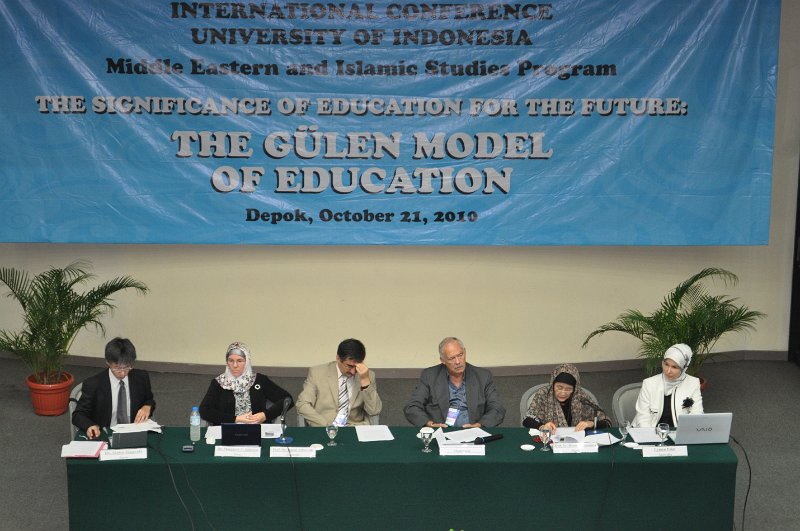
Just days before the latest catastrophic tsunami hit the West coast of Indonesia, an important conference was held in the heart of country’s capital, Jakarta, on Oct. 19-22.
In the poverty stricken country that hosts one of the world’s largest Muslim populations, the International Fethullah Gülen Conference opened its doors to scholars from around the world, and in particular from Southeast Asia, South Asia and Australasia, to discuss a most timely topic of “The Significance of Education for the Future: The Gülen Model of Education.”
 |
| Fethullah Gulen Conference |
In the poverty stricken country that hosts one of the world’s largest Muslim populations, the International Fethullah Gülen Conference opened its doors to scholars from around the world, and in particular from Southeast Asia, South Asia and Australasia, to discuss a most timely topic of “The Significance of Education for the Future: The Gülen Model of Education.”
October 29, 2010
Rumi Forum bestows Peace and Dialogue Awards
Ali H. Aslan
 The Rumi Forum, a think tank established by Turks living in Washington, D.C., to foster intercultural dialogue, has presented its traditional Peace and Dialogue Awards.
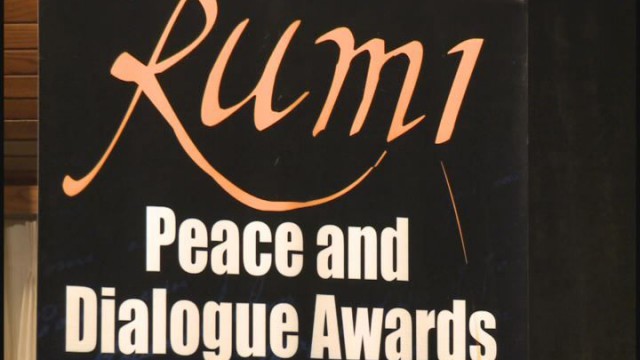
The 2010 Rumi Peace and Dialogue Awards ceremony was held on Tuesday at the National Press Club's Ballroom in Washington, D.C. The think thank gave awards to extraordinary individuals and organizations who have contributed much of their time, energy, leadership and dedication to the causes of dialogue, understanding, peace and community service.
The 2010 Rumi Peace and Dialogue Awards ceremony was held on Tuesday at the National Press Club's Ballroom in Washington, D.C. The think thank gave awards to extraordinary individuals and organizations who have contributed much of their time, energy, leadership and dedication to the causes of dialogue, understanding, peace and community service.
Kimse Yok Mu to distribute meat in 44 countries
Today's Zaman
A leading Turkish charity has organized an extensive campaign to deliver red meat to people in need in 44 countries around the world.
Kimse Yok Mu (Is Anybody There) is continuing its collection of livestock donations for the approaching religious festival of Eid al-Adha (Feast of the Sacrifice), during which all able Muslims are required to sacrifice an animal to God. The four-day festival will begin on Nov. 16.
A leading Turkish charity has organized an extensive campaign to deliver red meat to people in need in 44 countries around the world.
Kimse Yok Mu (Is Anybody There) is continuing its collection of livestock donations for the approaching religious festival of Eid al-Adha (Feast of the Sacrifice), during which all able Muslims are required to sacrifice an animal to God. The four-day festival will begin on Nov. 16.
October 27, 2010
The Hanefi Avcı affair: a dramatic detective story (2)
Faruk Mercan
Sarp Kuray, a former naval officer accused of having founded the 16 Haziran (or June 16) terrorist organization, says: “...The people who staged those attacks without my orders are freely walking around outside.
I, on the other hand, was sentenced to life in jail as the only convict…I myself am clueless about how the organization was able to gather so much intelligence.”
The meaning of these words is clear as daylight. Sarp Kuray is implying that control of the 16 Haziran organization was taken out of his hands by secret intelligence units within the state.
Sarp Kuray, a former naval officer accused of having founded the 16 Haziran (or June 16) terrorist organization, says: “...The people who staged those attacks without my orders are freely walking around outside.
I, on the other hand, was sentenced to life in jail as the only convict…I myself am clueless about how the organization was able to gather so much intelligence.”
The meaning of these words is clear as daylight. Sarp Kuray is implying that control of the 16 Haziran organization was taken out of his hands by secret intelligence units within the state.
October 26, 2010
The Hanefi Avcı affair: A dramatic detective story (1)
Faruk Mercan
When an incident or a scandal breaks, it is only natural for people to initially experience shock, especially if the protagonist of the event is an unexpected person. This is followed by the process of understanding the other side of the incident in question.
Hanefi Avcı, known to the Turkish public as a patriotic police chief who had adopted religious conservative values, committed to his family and dedicated to fighting terrorism and corruption was the main protagonist of an event that surprised us all.
When an incident or a scandal breaks, it is only natural for people to initially experience shock, especially if the protagonist of the event is an unexpected person. This is followed by the process of understanding the other side of the incident in question.
Hanefi Avcı, known to the Turkish public as a patriotic police chief who had adopted religious conservative values, committed to his family and dedicated to fighting terrorism and corruption was the main protagonist of an event that surprised us all.
October 18, 2010
‘The Gülen movement should prove its innocence’
Bülent Korucu
A wave of reactions has followed the book of now-arrested Police Chief Hanefi Avcı. Even those who don’t find Avcı’s claims plausible don’t hesitate to add the sentence, “But the Gülen community should prove its innocence.” This places the burden of proof on the defendant. The idea of saying, “Well, the onus is on you to be discharged of a liability,” is not logical, let alone legal. Another sentence which is easy on the ears these days is, “The community should become more transparent.” Our elders used to call this sort of thing “teklif-i malayutak,” meaning an unendurable offer.
A wave of reactions has followed the book of now-arrested Police Chief Hanefi Avcı. Even those who don’t find Avcı’s claims plausible don’t hesitate to add the sentence, “But the Gülen community should prove its innocence.” This places the burden of proof on the defendant. The idea of saying, “Well, the onus is on you to be discharged of a liability,” is not logical, let alone legal. Another sentence which is easy on the ears these days is, “The community should become more transparent.” Our elders used to call this sort of thing “teklif-i malayutak,” meaning an unendurable offer.
Transparency and the operational code of the Gülen movement
İhsan Yılmaz
During the course of the past few weeks, there has been a debate surrounding the Gülen movement and calls for the movement to be transparent.
I think these calls were misguided because they do not take into account the operational code of the movement and also seem to have a naive understanding of modern Turkish political history.
During the course of the past few weeks, there has been a debate surrounding the Gülen movement and calls for the movement to be transparent.
I think these calls were misguided because they do not take into account the operational code of the movement and also seem to have a naive understanding of modern Turkish political history.
October 15, 2010
Al-Zuhayli says Fethullah Gülen’s ideas hope of humanity
Cihan Yenilmez
Leading Islamic scholar Wahba Mustafa al-Zuhayli from Syria, a participant of the two-day Prophet’s Path Symposium held over the weekend, has said the ideas of well-respected Islamic scholar Fethullah Gülen stand as a hope for humanity.
Defining Gülen as a person with a wide horizon, he said the fact that Gülen adheres to Islamic values and that he does not draw opposition is met with admiration from the Islamic world.
Noting that Gülen gives hope to the Islamic world with his teachings, he said Gülen has shown that the future of humanity is bright.
 |
| Wahba Mustafa al-Zuhayli |
Defining Gülen as a person with a wide horizon, he said the fact that Gülen adheres to Islamic values and that he does not draw opposition is met with admiration from the Islamic world.
Noting that Gülen gives hope to the Islamic world with his teachings, he said Gülen has shown that the future of humanity is bright.
Infiltrating or contributing?
Muhammed Çetin
Over the past few days Muslim scholar and social activist Fethullah Gülen has given a measured and straightforward response to accusations that the Gülen movement, or as it is often called, the “volunteers’ service” or hizmet, is engaged in a conspiracy to infiltrate state institutions. Gülen replied that all citizens have a right -- in accordance with the law -- to be employed in their own country within the ranks of state institutions, including the police and military.
Indeed, it seems to me that since the participants and supporters of the movement number in the millions within Turkey, their presence within such institutions is a statistical certainty given that the movement is not a clandestine organization or cult.
Over the past few days Muslim scholar and social activist Fethullah Gülen has given a measured and straightforward response to accusations that the Gülen movement, or as it is often called, the “volunteers’ service” or hizmet, is engaged in a conspiracy to infiltrate state institutions. Gülen replied that all citizens have a right -- in accordance with the law -- to be employed in their own country within the ranks of state institutions, including the police and military.
Indeed, it seems to me that since the participants and supporters of the movement number in the millions within Turkey, their presence within such institutions is a statistical certainty given that the movement is not a clandestine organization or cult.
October 13, 2010
The Community [Gulen Movement]
Ahmet Turan Alkan
I have known them for around 20 years. I have eaten with them and had friendly chats with them. I haven’t seen any of them have a bad attitude, instead, they show respect and love. I will write down what I feel about them from a position, as described by famed Turkish poet Ahmet Haşim as: “Away from the earth somewhat further than halfway/ Closer to the moon somewhat further than halfway.”
Turkey has seen its likes a number of times, but has never met such a successful one. The people who love and rely on Fethullah Gülen and who undertake benevolent and education-related activities with inspiration from him have become a de facto reality in Turkey. This reality does not have a specific name or address. It has a voluntary and civilian character and, therefore, the word “community” generally used to describe it is treated as a dubious concept that hides, even obscures, its profundity. Interesting, those who can safely be defined as a “community” refrain from accepting this flippant and fuzzy concept, but still they cannot come up with an alternative designation except “hizmet” – literally meaning service, and in this specific use, implying a community of people whose sole purpose is to do service to religion and humanity.
I have known them for around 20 years. I have eaten with them and had friendly chats with them. I haven’t seen any of them have a bad attitude, instead, they show respect and love. I will write down what I feel about them from a position, as described by famed Turkish poet Ahmet Haşim as: “Away from the earth somewhat further than halfway/ Closer to the moon somewhat further than halfway.”
Turkey has seen its likes a number of times, but has never met such a successful one. The people who love and rely on Fethullah Gülen and who undertake benevolent and education-related activities with inspiration from him have become a de facto reality in Turkey. This reality does not have a specific name or address. It has a voluntary and civilian character and, therefore, the word “community” generally used to describe it is treated as a dubious concept that hides, even obscures, its profundity. Interesting, those who can safely be defined as a “community” refrain from accepting this flippant and fuzzy concept, but still they cannot come up with an alternative designation except “hizmet” – literally meaning service, and in this specific use, implying a community of people whose sole purpose is to do service to religion and humanity.
Fethullah Gülen: Citizens do not ‘infiltrate' state posts
Today's Zaman
Well-respected Turkish intellectual and scholar Fethullah Gülen has responded to claims that followers of the Gülen movement have infiltrated state posts -including those of the police force, the military and others- saying citizens of a country do not “infiltrate” the establishments that exist for the country and its citizens because it is a natural right for them to be employed in such posts.
“To urge fellow citizens to seek employment at state institutions is not called infiltration. Both the people urged and these institutions belong to the same country. … It is a right for them to be employed in state posts.
 |
| Fethullah Gulen |
“To urge fellow citizens to seek employment at state institutions is not called infiltration. Both the people urged and these institutions belong to the same country. … It is a right for them to be employed in state posts.
October 12, 2010
Turkey-KRG ties: How and why did they improve this much?
Abdulla Hawez Abdulla
I remember how relations between the Turkish government and northern Iraq’s Kurdistan Regional Government (KRG) used to be. Both sides were ambivalent about how to deal with the outlawed Kurdistan Workers’ Party (PKK), and had to wrangle over the matter. But these thoughts became obsolete after 2009 and transformed into marvelous relations. Some may wonder how and why they moved away from being enemies to being partners.
We should first mention that before this era of good relations between Turkey and the KRG, there was only one Turkish institution working in Arbil, the pro-Fethullah Gülen Fezalar Eğitim Kurumları (Fezalar Educational Institutes). But Fezalar stayed away from politics. Despite this, it has close ties with Justice and Development Party (AKP) ally the Kurdistan Islamic Union (KIU), and so Fezalar used KIU members to work with it.
I remember how relations between the Turkish government and northern Iraq’s Kurdistan Regional Government (KRG) used to be. Both sides were ambivalent about how to deal with the outlawed Kurdistan Workers’ Party (PKK), and had to wrangle over the matter. But these thoughts became obsolete after 2009 and transformed into marvelous relations. Some may wonder how and why they moved away from being enemies to being partners.
We should first mention that before this era of good relations between Turkey and the KRG, there was only one Turkish institution working in Arbil, the pro-Fethullah Gülen Fezalar Eğitim Kurumları (Fezalar Educational Institutes). But Fezalar stayed away from politics. Despite this, it has close ties with Justice and Development Party (AKP) ally the Kurdistan Islamic Union (KIU), and so Fezalar used KIU members to work with it.
‘Prophet Muhammad example of coexistence’
Ahmet Görçüm
 Delivering the opening speech for the İstanbul symposium, co-organized by the Turkish “Yeni Ümit” (New Hope) and Arabic “Hira” journals, on Saturday, Grand Mufti of Egypt Ali Gomaa added that there are lessons people should draw from Muhammad’s life in regards to maintaining peace with adherents of different religions and non-believers. “The qualities of the societies he lived in or with did not matter for him as he always knew how to coexist. We have to draw lessons for own our lives by taking his words, state management and service into account,” Gomaa said.
The common message emphasized by speakers at the two-day Prophet’s Path Symposium over the weekend was that the Prophet Muhammad exemplified how to live peacefully with “the societal other,” and that there are lessons people should draw from his life to secure peace in today’s world.

The common message emphasized by speakers at the two-day Prophet’s Path Symposium over the weekend was that the Prophet Muhammad exemplified how to live peacefully with “the societal other,” and that there are lessons people should draw from his life to secure peace in today’s world.
October 10, 2010
Fethullah Gulen discounts neither past nor modernity, concludes conference
Basri Dogan
 A conference titled “Mapping the Gülen Movement,” which took place in Amsterdam on Thursday, witnessed a detailed examination by academics and experts of various aspects of the Gülen movement.
Organized by the Dialoog Academie in the Netherlands, the international “Mapping the Gülen Movement” conference was held at the famous Felix Meritix Congress Center in Amsterdam. The conference was attended by many social scientists and academics from various universities, with one of the speakers well-known Turkish professor Doğu Ergil, who noted in his presentation that the Gülen Movement was a civil movement that called for maximum participation and support from its members.

Organized by the Dialoog Academie in the Netherlands, the international “Mapping the Gülen Movement” conference was held at the famous Felix Meritix Congress Center in Amsterdam. The conference was attended by many social scientists and academics from various universities, with one of the speakers well-known Turkish professor Doğu Ergil, who noted in his presentation that the Gülen Movement was a civil movement that called for maximum participation and support from its members.
October 8, 2010
It was the state yesterday, and so it is today!
Nuray Mert
Nowadays I am preoccupied by the traffic accident I had last week. Since I had to rest, I read Hanefi Avcı’s book “Devotee Residents of Haliç: Yesterday State, Today Religious Community.”
Usually excerpts on the Fethullah Gülen Movement are being discussed. But Avcı mentions so many other things that happened in the recent past. So, they need be opened to discussion, too. First of all, we see Avcı goes through a political-personal self questioning and explains how he questioned, in time, being the “Hunter of the State” – his last name means Hunter in English. I believe his “sincerity”. Summary of his political self-questioning is included in a section titled “It was the state yesterday, but the [Gülen] community today”.
I object to this summary.
Nowadays I am preoccupied by the traffic accident I had last week. Since I had to rest, I read Hanefi Avcı’s book “Devotee Residents of Haliç: Yesterday State, Today Religious Community.”
Usually excerpts on the Fethullah Gülen Movement are being discussed. But Avcı mentions so many other things that happened in the recent past. So, they need be opened to discussion, too. First of all, we see Avcı goes through a political-personal self questioning and explains how he questioned, in time, being the “Hunter of the State” – his last name means Hunter in English. I believe his “sincerity”. Summary of his political self-questioning is included in a section titled “It was the state yesterday, but the [Gülen] community today”.
I object to this summary.
October 2, 2010
Erbakan, Fethullah Gulen and Erdogan
Yasin Doğan
Years ago I wrote an article that discussed the differences in style and method between Necmettin Erbakan and Fethullah Gülen. The difference that became salient particularly during the Refahyol era, when the Welfare Party (RP) and the True Path Party (DYP) formed a coalition government, and during the Feb. 28 process was that Erbakan tended to give inward-oriented messages while Gülen would give outward-oriented ones.
The former would take into consideration the sensitivities of his own supporters while the latter would attach more importance to the sensitivities of other people and the people outside. Thus, Erbakan would have a difficult time embracing different groups and as a result his movement was perceived as an isolated and self-contained one. On the other hand, Gülen was seen as more open to the outside world and readier to embrace diversity.
Years ago I wrote an article that discussed the differences in style and method between Necmettin Erbakan and Fethullah Gülen. The difference that became salient particularly during the Refahyol era, when the Welfare Party (RP) and the True Path Party (DYP) formed a coalition government, and during the Feb. 28 process was that Erbakan tended to give inward-oriented messages while Gülen would give outward-oriented ones.
The former would take into consideration the sensitivities of his own supporters while the latter would attach more importance to the sensitivities of other people and the people outside. Thus, Erbakan would have a difficult time embracing different groups and as a result his movement was perceived as an isolated and self-contained one. On the other hand, Gülen was seen as more open to the outside world and readier to embrace diversity.
September 28, 2010
Of Fundamentalisms, Secular and Otherwise
Scott Appleby
The Task Force Report by the Chicago Council on Global Affairs Engaging Religious Communities Abroad: A New Imperative for U.S. Foreign Policy called for greater "religious literacy" across the "whole of government" and greater levels of interaction between nongovernmental institutions, American higher education and business, and select religious communities around the world. Not least, it urged the Obama administration to bolster U.S. advocacy and enforcement of religious freedom around the world.
The question is: With what kind of religious communities, specifically, should the United States engage? To what ends?
Many Americans and Europeans are taken aback, to say the least, by our suggestion that collaborating with religious groups on matters of shared concern is a necessary element of advancing democratisation and prosperity in many parts of the world.
The Task Force Report by the Chicago Council on Global Affairs Engaging Religious Communities Abroad: A New Imperative for U.S. Foreign Policy called for greater "religious literacy" across the "whole of government" and greater levels of interaction between nongovernmental institutions, American higher education and business, and select religious communities around the world. Not least, it urged the Obama administration to bolster U.S. advocacy and enforcement of religious freedom around the world.
The question is: With what kind of religious communities, specifically, should the United States engage? To what ends?
Many Americans and Europeans are taken aback, to say the least, by our suggestion that collaborating with religious groups on matters of shared concern is a necessary element of advancing democratisation and prosperity in many parts of the world.
September 27, 2010
Hanefi Avcı wrote book to create shield for himself, says Tayyar
Emrullah Bayrak
Şamil Tayyar, the author of “Operation Ergenekon,” “Shadow Government,” “Ambush” and other books that investigate unscrupulous groups inside the Turkish state bureaucracy, in his most recent book, “The Steel Core” released by Timaş Publications, says that Police Chief Hanefi Avcı wrote his recent book that attempts to undermine the Ergenekon investigation in order to create a protective shield for himself.
In his book, Tayyar offers evidence that a document drafted by Col. Dursun Çiçek as an army plot to discredit the Justice and Development Party (AK Party) government and the faith-based Fethullah Gülen movement was being implemented in Erzincan and Erzurum. He said that if that plot, known as the Action Plan to Fight Reactionaryism, had succeeded, a large number of AK Party members would today be in jail. He said illegitimate groups inside the military and the allies of these groups started a large-scale operation to eliminate the AK Party.
Şamil Tayyar, the author of “Operation Ergenekon,” “Shadow Government,” “Ambush” and other books that investigate unscrupulous groups inside the Turkish state bureaucracy, in his most recent book, “The Steel Core” released by Timaş Publications, says that Police Chief Hanefi Avcı wrote his recent book that attempts to undermine the Ergenekon investigation in order to create a protective shield for himself.
In his book, Tayyar offers evidence that a document drafted by Col. Dursun Çiçek as an army plot to discredit the Justice and Development Party (AK Party) government and the faith-based Fethullah Gülen movement was being implemented in Erzincan and Erzurum. He said that if that plot, known as the Action Plan to Fight Reactionaryism, had succeeded, a large number of AK Party members would today be in jail. He said illegitimate groups inside the military and the allies of these groups started a large-scale operation to eliminate the AK Party.
September 24, 2010
Has the Gülen movement become political?
Hüseyin Gülerce
The honorable Fethullah Gülen’s desire that a “yes” vote be cast during the Sept. 12 referendum is still being criticized by certain people. Can this movement, which is mentioned using Gülen’s name but Gülen himself insists on calling “the movement of volunteers,” become political?
There are certain people who even say, “This movement has expanded and in the end it’s bound to become political -- one day Fethullah Gülen will either become the prime minister or the president.”
Those who read Gülen’s books, those who listen to his lectures or those who are in this movement, if they happen to have a conscience and a sense of justice, will be able to say that this movement will never become political.
The honorable Fethullah Gülen’s desire that a “yes” vote be cast during the Sept. 12 referendum is still being criticized by certain people. Can this movement, which is mentioned using Gülen’s name but Gülen himself insists on calling “the movement of volunteers,” become political?
There are certain people who even say, “This movement has expanded and in the end it’s bound to become political -- one day Fethullah Gülen will either become the prime minister or the president.”
Those who read Gülen’s books, those who listen to his lectures or those who are in this movement, if they happen to have a conscience and a sense of justice, will be able to say that this movement will never become political.
September 19, 2010
Faith and reason

The Pope sounded the alarm about what he called the growing “marginalization” of religion in public life. There are those, he said, who want to “silence” the voice of religion altogether. Turkey’s Muslims could not have agreed with him more. Although the recent referendum on constitutional amendments in this strictly secular society dealt mainly with democracy and the concomitant restoration of civilian authority, the subtext of the debate within Turkish society is precisely what Benedict XVI articulated in his Westminster speech.
He goes straight into the heart of the issue: “What are the requirements that governments may reasonably impose upon citizens, and how far do they extend? By appeal to what authority can moral dilemmas be resolved?”
September 16, 2010
Muslim Networks and Movements in Western Europe
The Pew Forum on Religion & Public Life
The Gülen movement refers to a cluster of religious, educational and social organizations founded and inspired by Fethullah Gülen, a Turkish Islamic scholar, author and speaker now in his late 60s. The movement strives to give faithful Muslims the secular education they need to thrive in the modern world. At the same time, it also emphasizes the importance of traditional religious teachings. To this end, the movement has inspired the creation of a worldwide network of schools and other centers of learning that focus on secular subjects in the classroom but also offer extracurricular programs that emphasize religious themes.
The Gülen movement refers to a cluster of religious, educational and social organizations founded and inspired by Fethullah Gülen, a Turkish Islamic scholar, author and speaker now in his late 60s. The movement strives to give faithful Muslims the secular education they need to thrive in the modern world. At the same time, it also emphasizes the importance of traditional religious teachings. To this end, the movement has inspired the creation of a worldwide network of schools and other centers of learning that focus on secular subjects in the classroom but also offer extracurricular programs that emphasize religious themes.
September 14, 2010
Cardinal Wamala calls for dialogue between Muslims and Christians
Stephen Otage
 Christians and Muslims should use dialogue as a problem-solving mechanism, Cardinal Emmanuel Wamala has said. He made the appeal on Friday at a dinner hosted for a team of Catholic clergy by the Turkish Community in Uganda to celebrate Eid-el-Fitr in Kampala. “I am very happy to be here today celebrating Eid with our Muslim brothers. This is a visible spirit of co-operation, unity and love,” he said in a press interview.

Earlier, the cardinal said when people hear the word Muslim, what rings in their minds first is terrorism, which he said is wrong. The cardinal appealed to Turks in Uganda to follow and spread the message of love, tolerance and dialogue being spread by Fethullah Gulen, a Turkish preacher living in Pennsylvania, USA.
Mr Ejder Kilic, the chairperson of the Nile Humanitarian Organisation, an NGO managed by Turks in Uganda, said they are promoting education and fighting poverty to strengthen the fabric of humanity. The group invited cardinal Wamala and Ugandan clerics to visit Turkey which is believed to be the cradle of religion in the world.
Published on Daily Monitor 13 September 2010, Monday
September 10, 2010
An evaluation of Hanefi Avcı’s book
Emre Uslu
Hanefi Avcı recently published a book titled “Haliç’te Yaşayan Simonlar” (Simons in the Golden Horn). The book has created much controversy, due to Avcı’s position.
Before moving on to my assessment of the book, I should clarify my relationship with Avcı.
I don’t know him closely, but I like him very much. He was a police chief who became an idol for young police officers after statements he made during the Feb. 28 process. He was one of my references when I went to the US. He did not know, but many of my friends, the people I know and my teachers from the academy and I lobbied in his favor when the Justice and Development Party (AK Party) came to power. I wrote several articles about him. I knew the process of his appointment. Thanks to effective lobbying, he was appointed to the Anti-smuggling and Organized Crime Bureau (KOM) even though he did not expect it. In my opinion, his assignment to the KOM was the first move toward normalization in the balance between civilians and the military.
Hanefi Avcı recently published a book titled “Haliç’te Yaşayan Simonlar” (Simons in the Golden Horn). The book has created much controversy, due to Avcı’s position.
Before moving on to my assessment of the book, I should clarify my relationship with Avcı.
I don’t know him closely, but I like him very much. He was a police chief who became an idol for young police officers after statements he made during the Feb. 28 process. He was one of my references when I went to the US. He did not know, but many of my friends, the people I know and my teachers from the academy and I lobbied in his favor when the Justice and Development Party (AK Party) came to power. I wrote several articles about him. I knew the process of his appointment. Thanks to effective lobbying, he was appointed to the Anti-smuggling and Organized Crime Bureau (KOM) even though he did not expect it. In my opinion, his assignment to the KOM was the first move toward normalization in the balance between civilians and the military.
August 31, 2010
Former US ambassador praises Fethullah Gulen at MARTI-Rockville iftar
Today's Zaman
A former US ambassador has said he wishes Turkish intellectual Fethullah Gülen’s ideas will spread to the Arab world. David Newton, former US ambassador to Iraq and Yemen, said last week at an iftar (fast-breaking dinner) hosted by Maryland Turkish-American Inhabitants (MARTI), a non-profit organization established in December 2003, that “the mother of all values is tolerance.”
“Mevlana Jelaluddin Rumi is a great example of this [promoting tolerance], and he lived at a time when the world was not known for tolerance. Today, we need Fethullah Gülen’s ideas of tolerance, and I hope his ideas will spread to the Arab world,” he said about Gülen, one of the world’s most influential Islamic scholars. At the same dinner, County Executive Isiah Leggett noted that Maryland’s Montgomery county is unique in its great diversity, with students in their school district speaking 150 languages and coming from “literally all over the world.”
|
| Fethullah Gulen |
“Mevlana Jelaluddin Rumi is a great example of this [promoting tolerance], and he lived at a time when the world was not known for tolerance. Today, we need Fethullah Gülen’s ideas of tolerance, and I hope his ideas will spread to the Arab world,” he said about Gülen, one of the world’s most influential Islamic scholars. At the same dinner, County Executive Isiah Leggett noted that Maryland’s Montgomery county is unique in its great diversity, with students in their school district speaking 150 languages and coming from “literally all over the world.”
August 27, 2010
Fethullah Gulen says his call for ‘yes’ vote not linked to political motives
Today's Zaman
Turkish intellectual and scholar Fethullah Gülen, who recently said that the constitutional reform package to be presented to a public vote on Sept. 12 has amendments critical for the future of Turkey and had encouraged the public to vote “yes” in the referendum, has stated that his call is not related to any political party.
"We are willing to support anyone who takes steps to carry this country forward, and we will be the paving stones under their feet. We are at an equal distance to everyone. We would lend support to both [former Republican People’s Party (CHP) leader] Deniz [Baykal] Bey and [Nationalist Movement Party (MHP) leader] Devlet [Bahçeli] Bey if what they do means something for today and tomorrow for our nation in taking it to a position of leadership among world states,” Gülen said in his latest weekly speech broadcast on website Herkul.org.
 |
| Fethullah Gulen |
"We are willing to support anyone who takes steps to carry this country forward, and we will be the paving stones under their feet. We are at an equal distance to everyone. We would lend support to both [former Republican People’s Party (CHP) leader] Deniz [Baykal] Bey and [Nationalist Movement Party (MHP) leader] Devlet [Bahçeli] Bey if what they do means something for today and tomorrow for our nation in taking it to a position of leadership among world states,” Gülen said in his latest weekly speech broadcast on website Herkul.org.
August 24, 2010
Success and Recognition of Turkish schools in Australia
Çemen Polat
[Advancing in Education in an Advanced Democracy]
 Australia’s education system is considered to have some of the highest standards in the world and enjoys international recognition.
Over the past decades, Australia has emerged as one of the top five providers of international education services, after the US, the UK, Germany and France. Hence, Australia is widely renowned as being among the world leaders in the field of education, and each year the country attracts more than 450,000 students from about 200 countries. Education is Australia’s second largest services export sector, behind tourism, and became the third largest export overall, contributing $17.2 billion in export income to the economy in 2008-09, an increase of 23.2 percent from the previous financial year. While Australia is well regarded for providing high-quality education, attracting thousands of students from around the world, being able to develop a large-scale, internationally competitive education industry and having a comparative advantage in the English language, it has also been a destination for Turkish schools inspired by the philosophy of contemporary Turkish scholar, thinker, author, poet, educational activist and opinion leader Fethullah Gülen. Gülen-inspired schools in both their country of origin, Turkey, and abroad, particularly in Central Asia, the Balkans and African countries have attracted scholars’ attention from Western countries due to their continuous academic accomplishments, instructing subjects in English and emphasis on universal ethical values. These schools have delivered vastly elevated rates of student retention, graduation and matriculation in comparison to the state level of each of the countries in which they have been established.
[Advancing in Education in an Advanced Democracy]

Over the past decades, Australia has emerged as one of the top five providers of international education services, after the US, the UK, Germany and France. Hence, Australia is widely renowned as being among the world leaders in the field of education, and each year the country attracts more than 450,000 students from about 200 countries. Education is Australia’s second largest services export sector, behind tourism, and became the third largest export overall, contributing $17.2 billion in export income to the economy in 2008-09, an increase of 23.2 percent from the previous financial year. While Australia is well regarded for providing high-quality education, attracting thousands of students from around the world, being able to develop a large-scale, internationally competitive education industry and having a comparative advantage in the English language, it has also been a destination for Turkish schools inspired by the philosophy of contemporary Turkish scholar, thinker, author, poet, educational activist and opinion leader Fethullah Gülen. Gülen-inspired schools in both their country of origin, Turkey, and abroad, particularly in Central Asia, the Balkans and African countries have attracted scholars’ attention from Western countries due to their continuous academic accomplishments, instructing subjects in English and emphasis on universal ethical values. These schools have delivered vastly elevated rates of student retention, graduation and matriculation in comparison to the state level of each of the countries in which they have been established.
August 23, 2010
Gulen Movement: An Alternative to Fundamentalism
Matthias Daum
An interview with Helen Rose Ebaugh on the Gülen Movement:
Helen Rose Ebaugh, an American professor specializing in the sociology of religion, sees the movement founded by the controversial Turkish preacher Fethullah Gülen as both an opportunity for the West and a serious alternative to religious extremism. Matthias Daum asked for more details.
An interview with Helen Rose Ebaugh on the Gülen Movement:
Helen Rose Ebaugh, an American professor specializing in the sociology of religion, sees the movement founded by the controversial Turkish preacher Fethullah Gülen as both an opportunity for the West and a serious alternative to religious extremism. Matthias Daum asked for more details.
August 22, 2010
‘Gülen movement offers real alternative to clashes and conflict in society’
Can Bahadır Yüce
The Gülen movement has long been a part of Turkey’s social landscape. But in recent years interest in the movement has gone far beyond Turkey’s borders of the country, with discussions of Fethullah Gülen and his ideas in forums and platforms including the Arab League, the Russian Parliament, the European Parliament and the British House of Lords.
 There have been many attempts to define this civil initiative started by Gülen, a Turkish Islamic scholar well known for his teachings promoting mutual understanding and tolerance between cultures. In his recent book, titled “100 Soruda Fethullah Gülen ve Hareketi” (Fethullah Gülen and His Movement in 100 Questions), Professor Doğu Ergil, a distinguished political scientist, defines the movement as the only civil society organization that can represent Turkey’s impact, culture and human relations to the outside world comprehensively and effectively. Rice University Professor Jill Carroll, the author of the book “A Dialogue of Civilizations: Gülen’s Islamic Ideals and Humanistic Discourse,” says the movement is open to innovation and represents a chance for humanity.
The Gülen movement has long been a part of Turkey’s social landscape. But in recent years interest in the movement has gone far beyond Turkey’s borders of the country, with discussions of Fethullah Gülen and his ideas in forums and platforms including the Arab League, the Russian Parliament, the European Parliament and the British House of Lords.

August 18, 2010
Fethullah Gulen’s critics have no supporting evidence, says academic
Emre Oğuz

Ebaugh, the author of a book titled “The Gülen Movement: A Sociological Analysis of a Civic Movement Rooted in Moderate Islam,” was speaking at a conference organized by the Copenhagen-based Dialog Forum Foundation over the weekend. Stating that she received letters from some circles harshly criticizing Fethullah Gülen and the movement inspired by him after she began her research, Ebaugh said that when she called on them to prove their accusations they had failed to do so. She says they did not send her anything supporting their claims because such evidence does not exist.
Subscribe to:
Posts (Atom)
